
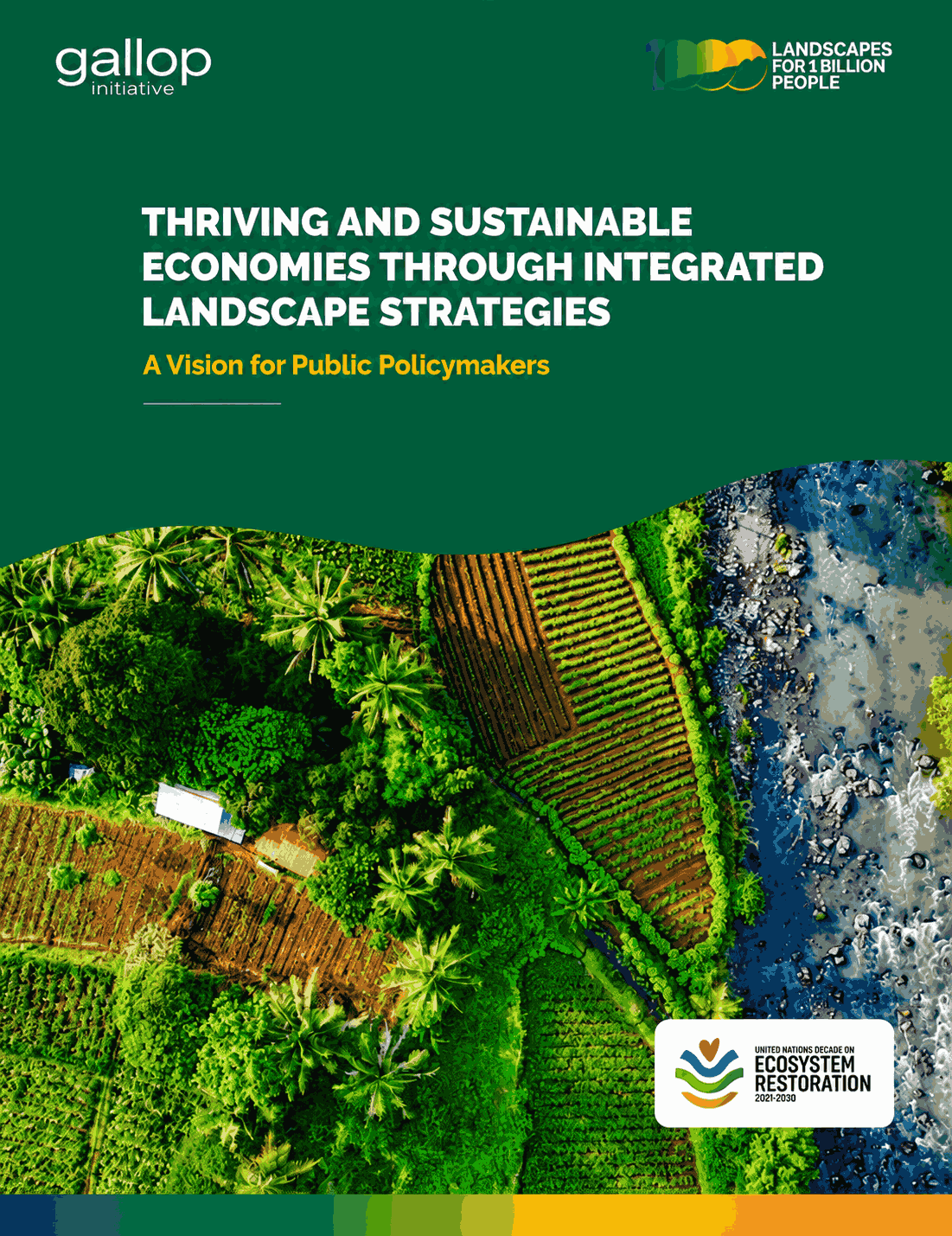
Thriving and Sustainable Economies through Integrated Landscape Strategies:
A Vision for Public Policymakers
Integrated landscape management (ILM) promises to be one of the most efficient and effective ways to address the interconnected polycrisis threatening the economy, society, and environment. Nurturing the whole landscape bottom-up through ILM yields high returns: a thriving economy, human well-being, healthy nature, and inspiration for a better future. This paper calls on policymakers working at all levels of government to join hands with local actors on the front line of the polycrisis to pursue the vision of ILM.
A public policy framework to support such a vision has three elements at its heart: designating a dedicated landscape agency within the government to serve landscape partnerships (LPs) and advise public and civil society policies and programs; ensuring government policies, programs, and budgets support LP-generated action and investment plans; and mobilizing support for landscape strategies across society, including markets, finance, digital infrastructure and education.
Background
First launched at COP30 in Rio de Janeiro in November 2025 as an Executive Summary, this paper builds on the prior work of GALLOP and 1000 Landscapes for 1 Billion People partners, including the:
- 2021 Territorial Approaches for Sustainable Development: Stocktaking on Territorial Approaches–Experiences and Lessons;
- 2023 White Paper on Public Policy to Support Landscape and Seascape Partnerships
- 2025 Advancing Landscapes and Seascape Restoration: The Case for Policy Coherence and Good Practice Sharing,
–as well as consultations with the 1000 Landscapes community.
Authors
Bhushan H. Sethi,
Steering Committee, 1000 Landscapes
Founder, GALLOP Initiative

Sara J. Scherr, PhD
Co-Founder, 1000 Landscapes
Founding ex-President & CEO, EcoAgriculture Partners

Downloads
Executive Summary
Short overview of the publication with key insights.
English
Español
Português
Français
Main Paper
Complete research publication with full recommendations.
English

Español

Português
Coming Soon
Français
Coming Soon
Endorsements
The current siloed approach to addressing environmental challenges has failed to deliver. An Integrated Landscape Management (ILM) approach, though demanding, is the pathway to achieving sustainable food and water security, restoring degraded land, conserving biodiversity, and promoting climate-resilient land and water management. I fully endorse the approach and strategies set out in Thriving and Sustainable Economies through Integrated Landscape Strategies – A Vision for Public Policymakers.
Dr. N H Ravindranath
Professor (Retd), Centre for Sustainable Technologies, Indian Institute of Science, Bangalore, India
If implemented in a concerted way, the mechanisms outlined in the Thriving and Sustainable Economies policy paper have the potential to address hunger, malnutrition, poverty, unemployment, and the broader challenge of sustaining high [economic] growth rates. The document is impressive in the pathways and solutions it offers for optimizing the allocation of underutilized land resources. It stands as an ideal toolkit for policymakers and implementing agencies working to solve pressing challenges in food security and economic empowerment.
Dr. K. Narayanan
Professor and HoD – Economics IIT Bombay
This policy paper provides a practical, evidence-based roadmap for embedding ILM into the heart of public policy. Kenya Landscape Actors Platform (KenLAP) stands ready to support its implementation, working to ensure that Kenya’s landscapes remain productive and resilient for people, nature, and the economy. KenLAP strongly endorses this policy paper as a timely and transformative contribution.
John Walker Recha (PhD)
Co-founder and National Coordinator
Kenya Landscape Actors Platform (KenLAP)
From an Ethiopian perspective, the paper offers a compelling and forward-looking framework that aligns closely with the country’s ESIF-II for Sustainable Landscapes Management. Its emphasis on aligning public investments and leveraging blended finance is particularly valuable for mobilizing resources at scale. We will share it with the Natural Resources Management Unit at Ethiopia’s Ministry of Agriculture, where its principles can help strengthen cross-sectoral alignment, landscape governance, and innovative financing.
Boris Buechler
Advisor / Technical Coordinator, Transformation of Agricultural and Food Systems
GIZ, Ethiopia
This is a comprehensive analysis of both the theory and practice of Integrated Landscape Management — rich in knowledge, best practice, and strategic guidance for policymakers and practitioners alike. Its emphasis on the role of local governments and communities in decision-making and implementation is spot on, and too often neglected by policymakers and designers of ILM strategies.
Joseph Epitu
Ministry of Water and Environment, Uganda