The biggest barrier to integrated landscape management (ILM) is not a lack of knowledge or evidence. It is the lack of a coherent policy framework that supports collaborative governance with landscape communities and supports local landscape partnerships.
This message was echoed by speakers earlier this year during a 1000 Landscapes for 1 Billion People webinar organized jointly with the Global Livelihoods and Landscape Recovery Platform (GALLOP). On August 13, more than 150 participants from 39 countries joined policymakers, researchers, and practitioners for Landscapes as Engines of Prosperity: A New Policy Vision for Integrated Landscape Management, which launched our new policy vision paper and explored how governments can better support locally led landscape partnerships.
Our paper, Thriving and Sustainable Economies through Integrated Landscape Strategies: A Vision for Public Policymakers builds on ideas first presented at the UN Framework Convention on Climate Change Conference of the Parties (COP30) in November 2025 in Brazil. The publication draws on consultations with the 1000 Landscapes community, as well as previous policy analyses by 1000 Landscapes partners on territorial approaches, public policy support for landscape approaches, and the case for policy coherence and good practice sharing.You can download the paper and its executive summary (in English, Spanish, French, and Portuguese) here , the powerpoint and webinar recording.
Our inspiring panelists shared their policy experience and insights (summarized here):
🌿 David Kuria, of the County (Regional) Government of Kiambu, Kenya
🌿 Karla Posada Quinteros, of the Ministry of Environment and Natural Resources, El Salvador
🌿 Prof. N.H. Ravindranath, of UNCCD and the Indian Institute of Science Bangalore
🌿 Dr. Caroline van Leenders, of the Netherlands Government Enterprise Agency
🌿 Prof. K. Narayanan, of the Department of Economics, Indian Institute of Technology Bombay
Although they represented very different countries and institutions, the panelists’ perspectives converged around common themes:
➡️ Communities need meaningful roles in policy decision-making – not just consultation.
➡️ Public investment, policy, and institutions must be aligned around places, not isolated projects.
➡️ Government agencies need to work across sectors instead of in silos in support of integrated, locally-designed landscape action plans.
➡️ Long-term coordination deserves the same attention as technical solutions and financing.
A Call to Action
By nurturing whole landscapes, ILM promises to be one of the most efficient and cost effective ways to address the interconnected challenges threatening the economy, society and environment–as a ‘poly-solution for the poly-crisis’. Landscape partnerships (LPs) have indeed proliferated around the world, as have integrated landscape programs and methods. But public policy – crucial to achieving scale of action and impact – has lagged behind.
The policy challenge. Today’s environmental and economic dysfunction can be traced back to an extractive model of development that has defined the last two centuries: nations have measured prosperity through their gross domestic product (GDP) while ignoring the natural capital that underwrites it. The result can be seen in hard numbers: a global debt-to-GDP ratio of roughly 3:1, only about 17% progress against the Sustainable Development Goals as reported by the G20 in 2024 in Brazil; humanity having crossed seven of the nine planetary boundaries tracked by the Stockholm Resilience Centre, and the repeated findings of the International Panel on Climate Change (IPCC). The Dasgupta Review, commissioned by the UK government with Cambridge University, demonstrated that depleting natural resources quietly erodes the economics underpinning growth itself. Moreover, communities who are directly managing land and resources and pursuing collaborative governance at the landscape level must be ensured an active role in policy formulation, not just consultation.
The core insight. Because all human activity ultimately depends on land and natural resources, these deserve to be treated as foundational assets rather than externalities. Governments should consider restoration and biodiversity not as cost centers, but reframe them as sources of economic value requiring spatially explicit (through GIS) integrated management. For finance ministries, this argument is most likely to be persuasive.
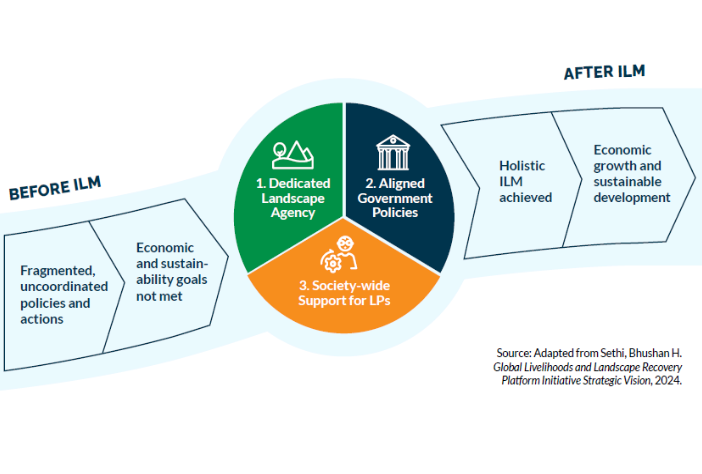
The institutional gap. The structural flaw is plain: governments maintain ministries for commerce, agriculture, and rural development, but no dedicated agency responsible for land and the people are managing it for all its values. This absence of a coordinating body is why policy stays fragmented and goals go unmet.
Policy to promote holistic ILM. The solution of integrated landscape management calls for a three-step architecture for reform:
- Establish a dedicated Landscape Agency — a coordinating body at the national or regional level to serve landscape partnerships and advise public and civil society to align policies and programs around land- and resources.
- Align other ministry actions — government policies, programs and budgets support action and investment plans generated by landscape partnerships.
- Mobilize support for integrated landscape strategies across society, including markets, finance, digital infrastructure and education.
This framework is more than a governance fix. It unlocks the full range of benefits: easing water and heat stress, restoring commons, ensuring efficient farming and agroecological practices, securing lasting roles for Indigenous communities, putting women at the center of development, and enabling new economic activity such as agri-processing, food exports, circular economies, and net-zero energy. The execution of landscape visions needs to be substantially underwritten by long-duration public finance and blended-finance instruments, which de-risk the landscape enough to attract private, institutional, and philanthropic capital aligned with the landscape vision.
We call on policymakers working at all levels of government to join hands with local actors on the front line of the polycrisis to adapt this vision to pursue ILM. Government leaders have the power to ensure all their nation’s landscapes and the economy thrive. Now is the time for concerted action to support landscape solutions. Since 2020, 1000 Landscapes, GALLOP and their partners are joining hands to build momentum and advocacy for this vision.